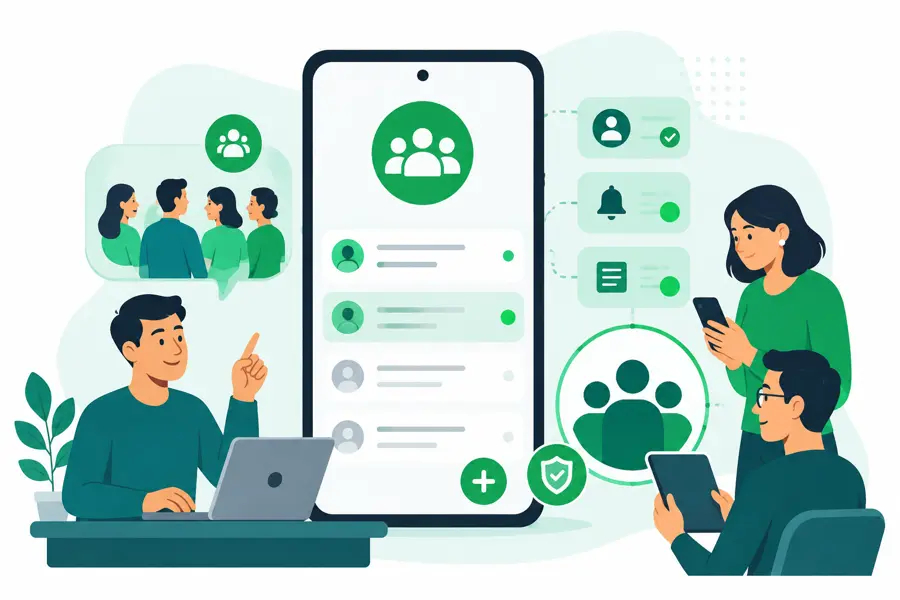
Meta has rolled out upgrades to WhatsApp group chats, including better admin controls, easier navigation and more ways to stay organised in groups you're part of. These changes are great for personal and community chats, but they don't solve the problems businesses face when they try to run customer engagement through groups, things like member limits, no opt-in tracking, and zero automation. For that, businesses need the official WhatsApp Business Platform, which is exactly what ODIV Engage is built on.
Meta has just announced fresh upgrades to WhatsApp group chats, making it simpler to find, manage and stay on top of the groups that matter to you. If you're a business owner who's been running customer updates or community chats through a WhatsApp group, this is worth understanding properly, both what's genuinely improved and where groups still fall short for business.
What exactly is Meta upgrading in WhatsApp group chats?
According to Meta Newsroom, the update focuses on making it easier to connect with groups you care about. In practice, this kind of upgrade usually touches a few areas that WhatsApp has been steadily improving over the last year:
- Better organisation, so you can find important groups faster instead of scrolling through a long, messy chat list.
- Stronger admin tools, giving group admins more control over who can post, add members, or change group settings.
- Smoother navigation between groups you're active in versus ones you've muted or rarely check.
- Improvements to how group updates, polls and shared media surface inside the chat.
None of this is flashy, but it solves a real, everyday frustration. Anyone managing even five or six active WhatsApp groups, a family group, a housing society group, a school parents' group, knows how quickly things get noisy and how easy it is to miss something important.
Why does this matter if you run a business on WhatsApp?
A lot of small and mid-size businesses in India already use WhatsApp groups informally. A boutique owner adds regular customers to a 'VIP Sale' group. A coaching institute creates a batch group for updates. A local gym has a members-only group for schedule changes. It's free, it's familiar, and everyone's already on WhatsApp anyway.
So when WhatsApp improves group admin controls or makes groups easier to navigate, it directly makes this informal way of doing business a little smoother. Fewer customers missing your announcement in a cluttered chat. Slightly better control over who can post junk in your group. That's a real, if modest, win.
Can businesses actually rely on WhatsApp groups to manage customers?
Up to a point, yes, and beyond that point, it starts to hurt more than it helps. Groups work fine when you have 30-40 loyal customers and you're mostly sending occasional updates. The trouble starts once your business actually grows.
Here's what typically goes wrong once a business tries to scale customer engagement through personal WhatsApp groups:
- Group size caps out at 1,024 members, so you can't grow one group indefinitely, you end up managing five or ten fragmented groups.
- Every member sees every other member's phone number, which is a privacy problem most customers rightly dislike.
- There's no way to segment, you can't message only the customers who bought a specific product or live in a specific city.
- No analytics. You can't tell how many people actually read your update, clicked a link, or took action.
- One customer spamming or complaining in the group can put your entire number at risk of being reported and banned.
- There's no automation, every reply, every order confirmation, every follow-up has to be typed manually by someone on your team.
WhatsApp groups are built for people who know each other personally. The moment a business tries to use them as a customer database, the cracks show up fast, no segmentation, no privacy for customers, and a real risk of your number getting flagged for spam.
How is a WhatsApp Business broadcast different from a group?
This is the distinction most business owners haven't fully made yet, and it matters a lot. A WhatsApp group is a shared space where everyone sees everyone. A broadcast, sent through the official WhatsApp Business Platform, sends a personalised message to each customer individually, they receive it as a normal one-on-one chat from your business, with no other customer visible, no group noise, and no risk of someone else hijacking the conversation.
On top of that, broadcasts sent through the Business Platform come with delivery and read reports, proper opt-in and opt-out handling as required by Meta's policies, and the ability to trigger automated follow-ups based on what the customer does next. A group simply cannot offer any of this, no matter how many admin controls Meta adds.
A WhatsApp group is where your customers talk to each other. A broadcast is where your business talks to each customer, personally, at scale.
What should a growing business use instead of WhatsApp groups?
Once a business crosses a few hundred customers, it's genuinely time to move from personal groups to the official WhatsApp Business Platform (Cloud API). This is the same infrastructure that lets large brands run WhatsApp at scale, and it's now accessible to small businesses too, without needing a developer team.
This is exactly the gap ODIV Engage is built to fill. Instead of a group where 500 customers see each other's numbers, you get a proper CRM with a shared team inbox, so every conversation is private, organised, and assigned to the right person on your team. Instead of manually typing the same update 500 times, you run a broadcast campaign that reaches every segmented list, festival shoppers, repeat customers, cart abandoners, in one go, with delivery reports to show for it.
How does ODIV Engage help beyond just messaging?
Once you move off groups and onto a real Business Platform setup, a lot more becomes possible. With ODIV Engage, businesses can:
- Build a no-code AI 'Vibe' bot that answers FAQs, shares your catalog, and books appointments automatically, day or night.
- Send segmented broadcast campaigns instead of one noisy group blast to everyone.
- Let customers browse and buy directly on WhatsApp using catalog, cart and payment features.
- Set up a booking bot connected to your calendar, so customers can reserve a slot without a back-and-forth chat.
- Capture leads through simple WhatsApp Flows or a website chat widget and see them land straight in your CRM.
- Automate follow-ups, order updates and reminders so nothing depends on someone remembering to type it manually.
The best part is you don't need to rebuild everything overnight. Many businesses start small, a WA Broadcast Lite plan for simple updates, or an Appointments plan for booking, and grow into the full platform as their needs expand. If you've been managing customers through a WhatsApp group and are starting to feel its limits, it's worth taking a look at how a proper WhatsApp Business setup with ODIV Engage compares. You can start a free trial and see the difference within a day, no need to migrate everything at once.
Check current plans and start your trial at engage.odivend.com/pricing. Setup is quick, and our team is happy to help you figure out the right starting plan for where your business is today.
