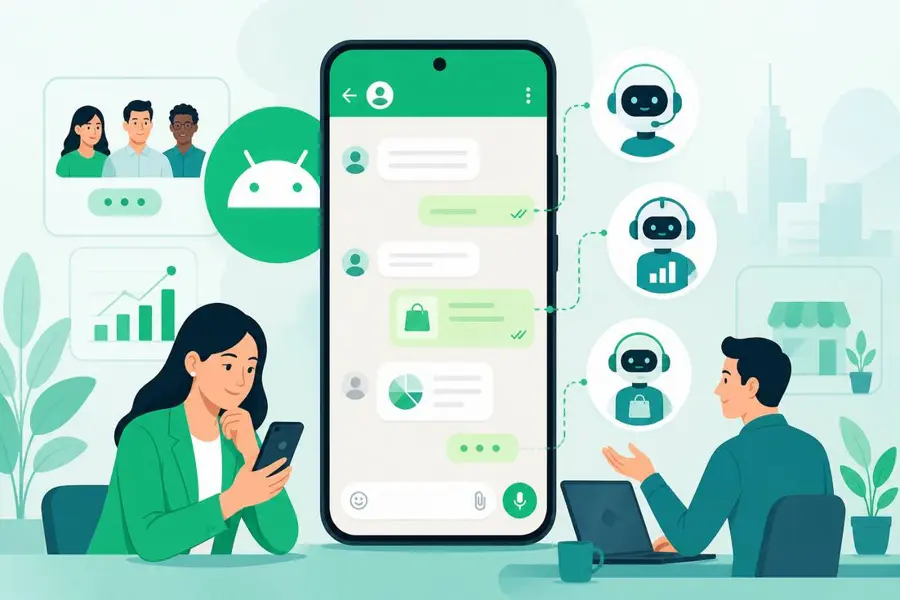
WhatsApp is rolling out support for third-party AI agents on Android, spotted in beta version 2.26.35.3, letting users connect up to five external AI services and chat with them in dedicated threads. The rollout is limited to select countries with no official wider launch date confirmed yet, but it signals a bigger shift: WhatsApp is opening up to become a hub where customers pick their AI, not just the business's own bot, so businesses need conversation designs and handoffs that hold up regardless of which AI is on the other end.
WhatsApp is quietly testing a feature that changes the basic assumption behind every business chat on the app: that the AI a customer talks to is the one the business built. Third-party AI agents on Android, spotted by WABetaInfo in beta version 2.26.35.3, let a user add external AI services directly inside WhatsApp settings and talk to them in dedicated chats, up to five agents per account. If this expands, businesses on WhatsApp will need to design conversations and handoffs assuming the customer may be juggling multiple AIs, not just yours.
What exactly did WhatsApp roll out on Android?
According to reporting reviewed for this piece, WhatsApp's Android beta now shows an option to connect a third-party AI agent, meaning an AI service that isn't built or owned by WhatsApp itself. Once connected, that agent gets its own chat thread inside WhatsApp, just like a contact. Users can hold up to five such agents at a time, and adding a sixth requires disconnecting one first. This was spotted in the app, not announced formally by Meta with a full feature page or public statement, and there's no confirmed date for when it moves beyond the current limited, gradual rollout in select countries.
Nothing in the source confirms this specific feature is live for WhatsApp Business accounts yet. It appears to be a personal-account, consumer-facing capability for now. But the direction matters more than the current scope. WhatsApp has spent years positioning itself as the place where a business's own AI answers customer questions. This feature suggests a parallel track where users bring their own AI helpers into the same app, sitting right next to your business chat.
How does adding a third-party AI agent actually work?
Based on what's been reported, the flow is straightforward from a user's point of view:
- Open WhatsApp settings on Android and look for the option to add or connect an AI agent.
- Configure the external agent, presumably authenticating it or linking an account with that AI provider.
- The agent then appears as a dedicated chat thread, separate from regular contacts and business chats.
- Repeat for up to five agents; adding a sixth means removing one first.
What isn't clear yet is how these third-party agents will interact with business chats, if at all. Right now it reads as a standalone consumer feature, not a bridge that automatically pulls a business's customer service into a third-party AI. But WhatsApp features that start narrow rarely stay that way for long.
Is this connected to Meta's own Business AI push in India?
There's a separate but closely related development worth knowing. Meta has already launched Business AI for small businesses in India on WhatsApp, available in native Indian languages, meant to help businesses respond to customer queries 24/7, capture leads, book appointments and drive sales. Eligible businesses find it under the Tools tab as 'Your Business AI.' At launch it was limited to selected businesses meeting eligibility criteria, with Meta saying it would extend to more eligible businesses over the coming weeks. Separate coverage has also described Meta's Business Agent as able to connect with workflows and software like Shopify and Zendesk, operating alongside the regular WhatsApp Business Platform.
So there are two threads running in parallel: Meta's own Business AI for merchants, and this newer, distinct experiment letting individual users plug in outside AI services. They're not confirmed to be the same feature, but both point to WhatsApp becoming a more crowded, more automated place to have a conversation.
Why is WhatsApp introducing token-based pricing now?
Reports indicate WhatsApp introduced token-based pricing for AI agents effective August 1, 2026, with one figure quoted at roughly $2 per 1 million tokens for using the Meta Business Agent. Separate industry coverage suggested the business agent was free to trial until that date, after which a typical 1,000 to 3,000 token reply would cost somewhere around $0.002 to $0.006, before Meta's own per-message conversation fees. These figures come from secondary reporting and aren't independently verified against an official Meta pricing page, so treat them as directional rather than final.
Still, the signal is clear enough. AI-generated replies on WhatsApp are moving from 'free extra' to a metered cost, layered on top of WhatsApp's existing per-conversation pricing. For any business running high message volumes, that's a real budgeting line, not a footnote.
Whether or not third-party AI agents reach business accounts directly, the underlying shift is real: WhatsApp is becoming a multi-AI environment where customers may have their own assistants, your AI agent has a token cost attached, and the platform itself faces regulatory pressure to stay open. Businesses that treat their WhatsApp AI as a one-off setup will find themselves rebuilding it every few months. Businesses running it on a managed platform with proper handoffs, cost controls and a human inbox behind it won't.
What did the EU ruling on third-party AI chatbots add to this?
In a closely related development from the past month, the EU reportedly ordered Meta to reopen WhatsApp to rival AI chatbots, giving Meta five working days to reinstate access for third-party general-purpose AI assistants to the WhatsApp Business API under previous terms. Read alongside the Android beta feature, it paints a picture of a platform under pressure from two directions at once, regulators pushing for openness to outside AI, and Meta simultaneously building its own AI tools and monetising them through token pricing. For a business owner, the practical takeaway isn't which side wins that argument. It's that the rules around AI on WhatsApp are moving, and conversation flows built rigidly around today's assumptions will need adjusting sooner than you'd like.
The businesses that win aren't the ones with the fanciest bot. They're the ones whose customer, whenever they land on WhatsApp, always gets a fast, correct answer, and a real person the moment the bot runs out of road.
How do you build a WhatsApp AI setup that survives all this change?
This is exactly where ODIV Engage's trainable AI Agents and Automations Builder earn their place, because the answer isn't to chase every WhatsApp feature update, it's to run your customer conversations on a layer that adapts underneath you.
Concretely, here's what a non-technical owner sets up in ODIV Engage:
- Use the DIY + AI 'Vibe' Bot Builder to describe your business in plain language, and let it draft a first-line WhatsApp bot that answers FAQs, shares your catalog, and captures leads, without writing a single flowchart yourself.
- Train an AI Agent on your actual product list, pricing, and policies, so it answers like someone who works at your shop, not a generic assistant.
- Set up the Automations Builder to hand off any conversation the AI can't resolve, or any customer who types 'talk to a person', straight into the shared team Inbox, where your staff sees the full chat history and replies from one screen.
- Add Calendar booking bots or WhatsApp commerce (catalog, cart, payments) on top, so the same AI agent that answers a query can also book an appointment or close a sale, right inside the chat.
The reason to do this on ODIV Engage rather than wiring the raw WhatsApp Cloud API yourself is simple: it's already built, tested on real Indian merchant accounts, and supported when Meta changes something, so you're not the one debugging token pricing or new agent limits at midnight. Quick-start plans begin at Rs 70/mo for a single need like WhatsApp Broadcast Lite or RCS Lite, and the full platform, bot builder, automations, AI agents, shared inbox, commerce and campaigns together, starts at Rs 999/mo on Starter, going up to Growth at Rs 1,999/mo and Scale at Rs 4,999/mo as you grow. Start a free trial and see your own WhatsApp AI agent live within the day at https://engage.odivend.com/pricing.